A 2,800 kW geared drive comes out; two gearless motors go in
In the third quarter of 2023, Swedish iron-ore miner LKAB awarded ABB a contract to re-drive an existing belt conveyor at its Malmberget mine near Gällivare — the TR020 conveyor in International Mining's naming, a 25-year-old system that carries up to 15 million tonnes of iron ore a year, some 80 percent of the mine's production. The existing drive was a single 2,800 kW wound-rotor induction motor working through a gearbox. The replacement, ABB's Gearless Conveyor Drive, is a pair of permanent-magnet motors coupled directly to the existing drive pulley, with no gearbox at all. ABB's contract announcement rates the two models at 1,600 kW each; International Mining's post-completion feature records the installed motors at 1,625 kW apiece and the new drive system's defined total power at 3,250 kW — a small discrepancy worth noticing, because it is exactly the kind of figure a retrofit contract should fix in one place. The work sits about 1,250 metres underground, in a drive station where space and transport routes are limited. ABB's announcement projected overall energy savings of between 6 and 10 percent once the upgrade was complete in 2025 — a projection, stated before the fact, and worth remembering as such when the savings discussion below turns to measurement.
The retrofit question: when the gearbox becomes the liability
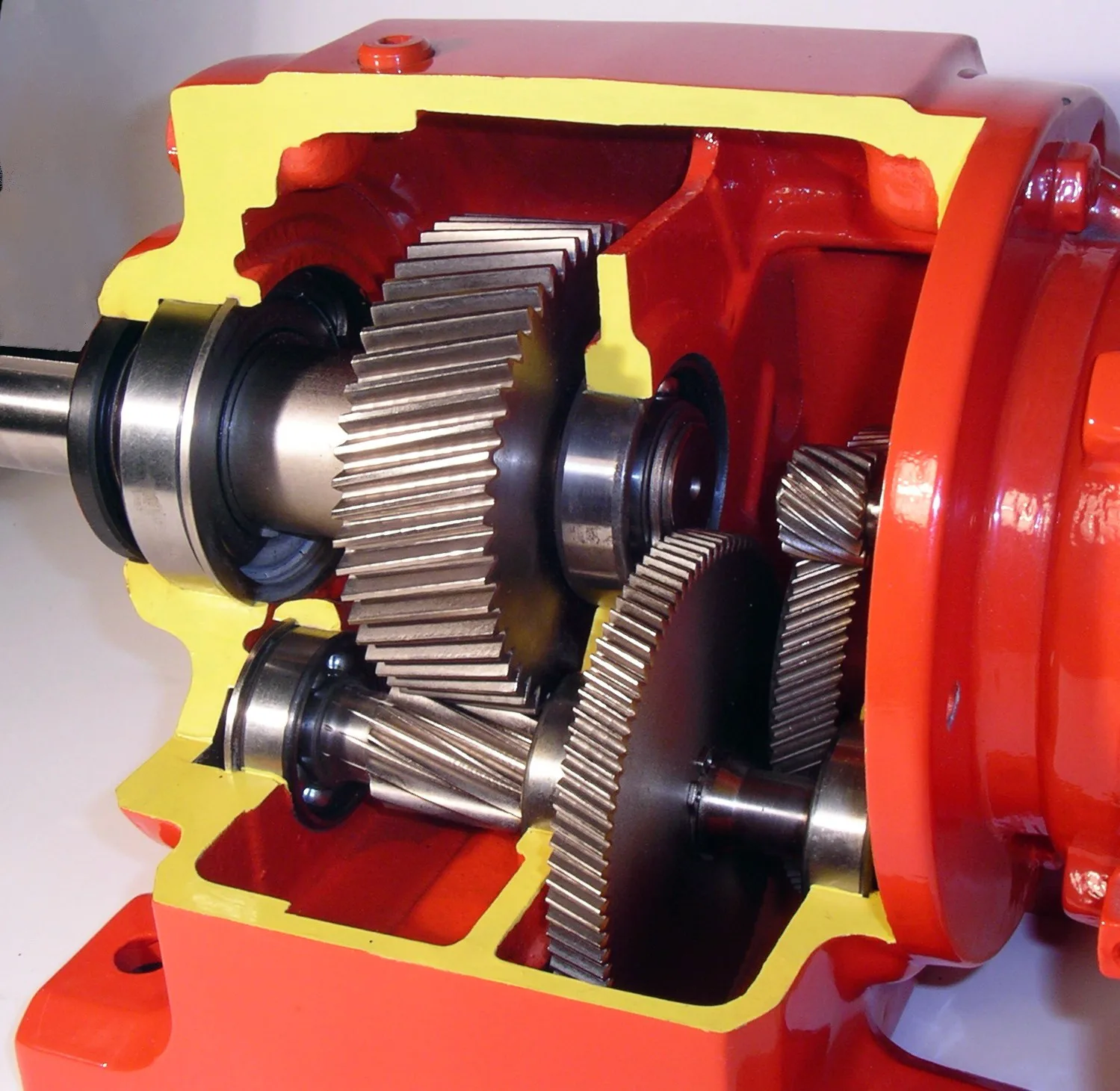
A gearless retrofit only makes sense as an answer to a specific diagnosis: the conveyor's structure, belt and pulleys still have service life, but the drive train — motor, gearbox, couplings, lubrication — has become the reliability and maintenance bottleneck. Removing the gearbox removes the component with the densest maintenance schedule in the train: no gear oil, no oil cooling, no gear-mesh wear to trend, and, as both ABB and International Mining note in this case, a smaller fire load, less noise and less heat in the drive station. In exchange, the motor itself becomes a low-speed, high-torque machine that must deliver full torque at pulley speed — at Malmberget the defined pulley speed is 43 rpm — and it arrives as a large, heavy unit that has to be transported and installed in the space the old train vacates. The LKAB case also bundled a second objective into the same shutdown: the new system was specified for a higher duty, with the target mass flow of 3,600 t/h reached by raising the belt speed to 3.6 m/s, so the retrofit was simultaneously a capacity project. Buyers should be clear about which of these they are purchasing — a like-for-like reliability swap, a capacity increase, or both — because the specification, the acceptance tests and the price are different in each case.
Specify the interfaces with the conveyor you already own
In a retrofit, the new drive must fit a machine that already exists, so the specification starts with an audit of what stays. The fixed points in this case are typical: the existing drive pulley, which the permanent-magnet motors couple to directly, and its shaft and bearing arrangement; the available envelope in the drive station and the largest piece that can be transported to it at roughly 1,250 m depth; the electrical supply and the low-voltage frequency converter the direct drive runs from; and the control handover to the mine's existing systems. Each belongs in the enquiry as measured data, not assumptions. The duty change makes the audit wider than the drive station: raising belt speed to lift mass flow touches belt rating and splice strength, idler spacing and speed limits, transfer-point behaviour and the capacity of everything downstream of the conveyor. A retrofit specification that prices only the drive swap and discovers the belt-side consequences later has simply moved its budget risk. The Malmberget parameters that International Mining published after completion — 3,600 t/h target mass flow, 3,250 kW total drive power, 43 rpm pulley speed, 3.6 m/s belt speed — are a useful template for the minimum defined-parameter set a buyer should demand in writing before comparing retrofit offers.
The shutdown window is negotiated, not hoped for
The commercial heart of this retrofit was not the motors; it was the calendar. ABB's 2023 announcement said installation would take place during scheduled maintenance stops, with final commissioning due in August 2025. What actually happened, per International Mining's post-completion account, is tighter and more instructive: dismantling of the old drive and installation of the new ones were both executed inside the mine's annual two-week general maintenance period, and the conveyor was back in operation on the new direct drive in May 2025, with drive optimisation carried out in parallel with the production ramp-up, in ABB product manager Ulf Richter's words to International Mining. For a buyer, that sequence translates into contract language: the window is a defined number of days inside a named maintenance stop; the scope that must be complete before the window opens — pre-assembly, transport to the drive station, rigging studies — is listed separately from the work allowed inside it; and the agreement states what happens if the window overruns, who carries the production loss, and whether optimisation after restart is inside or outside the price. A retrofit quoted without a window plan is a quotation for equipment, not for a changeover.
Savings claims need a measurement basis agreed in advance
This case also shows how energy claims travel. The 6 to 10 percent saving entered the record as a projection in ABB's contract announcement, before any new equipment had run. International Mining's post-completion feature, published after the conveyor had operated on the new drives, reports a different kind of figure — a 20 percent increase in the conveyor's production capacity — and no measured energy-saving percentage. Neither number is dishonest, but they answer different questions, and a buyer who files the projection as the result will misjudge the investment. A retrofit agreement should therefore fix the measurement basis before the old drive comes out: the baseline is the existing drive's energy per tonne over a defined production period; the comparison period, the throughput band and the boundary of what is metered — drive package alone or the whole conveyor — are agreed in advance; and any savings guarantee states whether it is settled on nameplate ratings, on the defined system parameters (in this case the 3,250 kW total and 3,600 t/h duty), or on metered operation. The 1,600 versus 1,625 kW naming gap between ABB's announcement and International Mining's feature is trivial in engineering terms, but it makes the same point: ratings that are not pinned to one document will drift between documents.
What this case is not: package buying and system electrification
This article treats one decision — whether and how to rebuild the drive of a conveyor you already own — and it should not be confused with two neighbouring questions covered elsewhere in this series. Buying a new geared drive train as one integrated package, with a single interface list and package-level acceptance, is a new-purchase specification problem; the earlier piece on BMG's turnkey drive packages covers it, and nothing in the Malmberget retrofit re-opens that package composition. Electrifying a long-distance overland system — how drive stations are arranged along kilometres of conveyor and how they are supplied — is a system-architecture question, addressed by the scheduled piece on overland conveyors in the electrified mine; a single conveyor's drive swap is executed inside such an architecture, not as a substitute for it. The retrofit decision is narrower and, in one respect, harder: its baseline is a running asset with a production obligation, so every specification choice is also a negotiation about downtime. The question the LKAB case leaves on the table for any owner of an ageing, high-power conveyor is the one LKAB answered in 2023: at what point does the next gearbox overhaul cost more — in money, risk and lost flexibility — than removing the gearbox altogether?
Manufacturer announcements and our analysis are distinguished. Product claims require verification for the specific application.
Sources
ABB conveyor drive technology will enable LKAB underground mine to significantly increase energy efficiency ↗ABB's official contract announcement (November 2023), opened in full: source for the Q3 2023 award, the existing 2,800 kW wound-rotor motor and gearbox, the two 1,600 kW permanent-magnet GCD models, the 1,250 m underground installation, the 2025 completion plan and the projected 6–10 percent energy saving, which the release states as an expectation, not a measured result.
ABB completes GCDs for LKAB's Malmberget conveyor modernisation — International Mining, February 2026 ↗International Mining's post-completion feature (February 2026), opened in full: source for the installed motors recorded at 1,625 kW each, the defined system parameters (3,600 t/h, 3,250 kW total, 43 rpm, 3.6 m/s), the two-week maintenance-window changeover, operation on the new drives since May 2025 and the reported 20 percent capacity increase. Its 815 m depth figure differs from ABB's 1,250 m; this article follows ABB.
Gearless drives for the Malmberget TR020 conveyor — International Mining, February 2025 ↗International Mining's earlier project report (February 2025), opened in full: names the conveyor as TR020, dates the ABB contract to Q3 2023 and carries LKAB project owner Pär Sundqvist's statement of the upgrade's throughput and energy targets — the owner's framing of the retrofit decision before completion.