In October, monitoring stopped being a single-device purchase
Australian Mining's October 2026 feature on Flexco describes an Elevate portfolio that now does two jobs under one platform name. The first is belt rip prevention: continuous analysis that detects belt damage and can stop the conveyor automatically. The second is cleaner monitoring: a small device on the belt cleaner that reports whether the cleaner is working, and feeds the same dashboard. Neither function is new on its own. What changed is the packaging: a major conveyor supplier now sells rip protection and cleaner condition as one connected monitoring offer, with a shared dashboard and machine-learning assessment behind both.
For buyers, the packaging matters more than the launch. Once monitoring is sold as a platform rather than as isolated devices, it can be specified like one: the purchase order for a belt, a cleaner package or a conveyor upgrade can name the monitoring functions, the data the site will receive and the acceptance evidence the supplier must produce. Monitoring stops being an accessory the maintenance team bolts on later and becomes a line item the buyer can compare across offers.
Two layers that answer two different failure questions
The rip-prevention layer watches for the event every belt operator fears: a longitudinal tear that can destroy a belt in one shift. According to Australian Bulk Handling Review's account of the system, originally developed by SHG Conveyor Control and acquired by Flexco, it does not read the belt directly. It analyses the drive motor's electrical signals - voltage, harmonics and related patterns - and a calculation model looks for the signature of a rip or anomaly. On detection it can send an output signal to the conveyor's PLC so the drive stops automatically. There are no sensors embedded in the belt and no laser or camera line to keep clean, a contrast the developer draws against inductive, magnetic and laser-based systems.
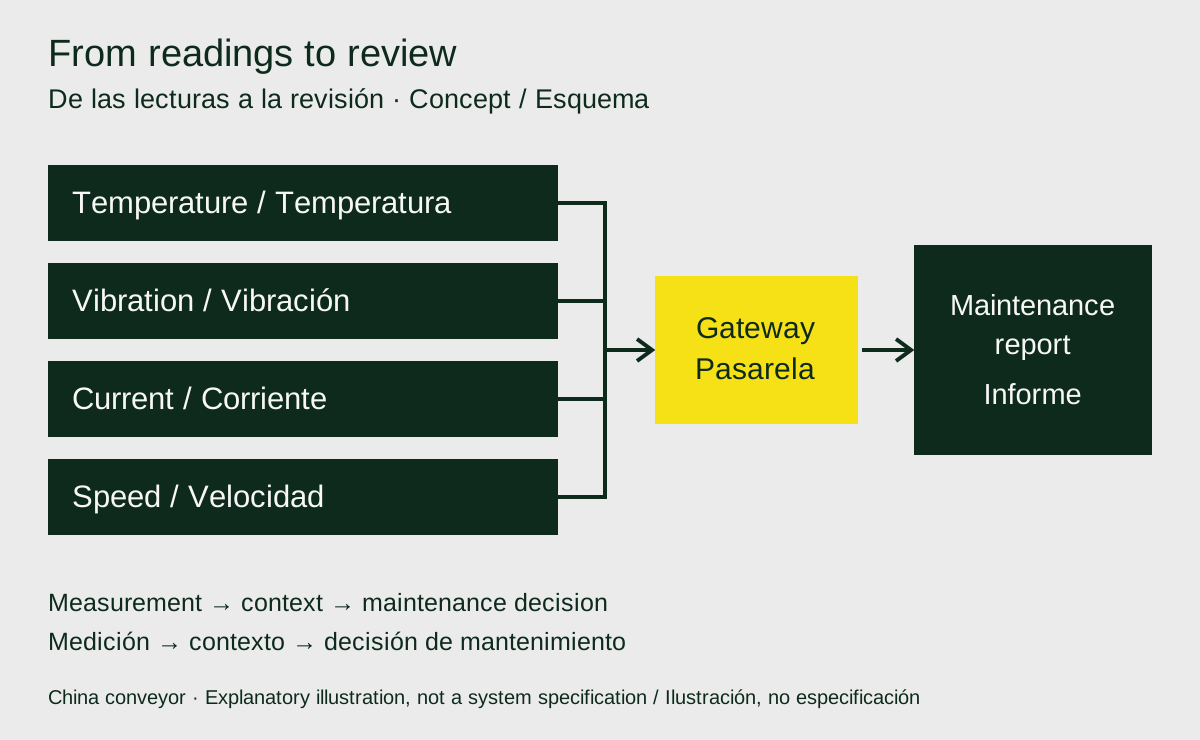
The cleaner layer answers a slower question: is the cleaner still doing its job between inspections? Flexco's i3 device slides onto the end of the cleaner pole and transmits over cellular or Wi-Fi to the Elevate dashboard. Flexco lists the data as blade performance, cleaner engagement, blade run-time, belt status and projected blade life, with machine learning used to judge whether the cleaner is maintaining effective contact with the belt. One layer protects against a sudden, catastrophic loss; the other against the gradual carryback and wear that a missed inspection hides. A specification should treat them as separate functions with separate evidence, not as one vague promise of monitoring.
The quarry case shows the value - and the limits of vendor evidence
The Australian Mining feature rests on a documented event at Cemex's Dove Holes quarry in the UK. In April 2025 a steel plate fell from the primary crusher onto the conveyor below. The rip-prevention system detected the damage and stopped the belt within 12 metres, before the tear could run the length of the conveyor. The quarry's assistant manager credits the system with saving the belt outright, and the site later extended it to more conveyors. The feature puts the site's downtime cost at up to 20,000 pounds per hour and a typical rip repair at up to 48 hours, which is the arithmetic that makes automatic detection easy to justify.
Buyers should still read the case as what it is: one site, reported by a trade magazine, built around the supplier's chosen example. The downtime figure is the site's estimate, not an audited number, and a limestone quarry's cost structure will not match a port, a coal plant or an underground mine. The case proves the detection-and-stop sequence can work in production conditions. It does not prove detection performance on your belt, your drive or your material - that has to be established in your own acceptance process, which is where the specification earns its keep.
Write the monitoring functions into the purchase specification
Start with functions, conveyor by conveyor. Name which conveyors get rip prevention, which cleaners get monitoring devices, and what each function must do: detect and signal, or detect and stop. For any automatic stop, the specification should identify the interface - the signal the monitoring system hands to the conveyor's PLC or control system - and who is responsible for integrating and testing it. A detection system whose stop output nobody has wired in is an alarm, not protection.
Then specify the data, not just the devices. List the fields the site will actually receive - cleaner engagement, blade run-time and projected blade life in the cleaner layer; event records and anomaly reports in the rip layer - and state how the site accesses them: dashboard seats, data export, retention period and what happens to the data when a subscription ends. Cover the unglamorous parts in the same document: who provides cellular or Wi-Fi coverage at each conveyor, who replaces a failed device and within what time, and whether monitoring is priced as a licence, a subscription or a one-off supply. These are commercial terms, and they are far easier to settle before the order than after the first renewal invoice.
Acceptance questions to ask before you sign
Ask how the system earns its keep on your conveyor, in writing. Five questions cover most of the risk. What event evidence exists beyond the launch case - reference sites with a similar belt, drive and duty, and what did the system catch or miss there? How are detection thresholds set for each conveyor, and who adjusts them after commissioning? What does the supplier count as a false alarm, how are false alarms and missed events recorded, and what response do they trigger? For the cleaner devices, verify the retrofit claim against your own cleaner models: Flexco says most cleaners can be connected in five minutes or less, which is a vendor statement to test on your poles, tensions and access conditions, not a number to copy into a plan. Finally, who in your organisation owns the alert when it arrives at 2 a.m. - a monitoring contract that ends at the dashboard leaves the response, and the risk, with you.
What a monitoring platform still does not see
Keep the boundaries in view. A rip-prevention layer reads drive signatures and a cleaner device reads cleaner behaviour; neither inspects idler bearings, splice workmanship, structure or chute wear, and neither replaces the physical inspections that find those problems. The textile-belt monitoring covered elsewhere on this site takes the opposite approach - sensing inside the belt itself - and drive-level monitoring of motorised pulleys is a third, different scope. Buyers comparing offers should not let one platform's dashboard blur those distinctions.
The practical conclusion is modest but real. Monitoring has become a legitimate specification topic: functions, interfaces, data rights and acceptance evidence can all be written into an order today, using the questions above. What has not changed is the burden of proof. Treat platform claims - detection performance, install times, projected blade life - as vendor statements to be verified at acceptance on your own conveyors, and keep the inspection regime that covers everything the sensors do not.
Manufacturer announcements and our analysis are distinguished. Product claims require verification for the specific application.
Sources
Flexco takes belt monitoring to new heights ↗Trade feature dated 15 October 2026 describing the expanded Elevate portfolio (belt rip prevention plus i3 cleaner monitoring under one platform) and the Cemex Dove Holes case. The downtime and repair figures are the site's estimates as reported, not independently audited values.
The future of AI belt rip detection ↗Trade report (June 2026) explaining the rip-prevention mechanism: analysis of drive-motor electrical signals with an output to the conveyor PLC, developed by SHG Conveyor Control before its acquisition by Flexco. Performance advantages quoted in it are the developer's claims.
Flexco Elevate: Smart Belt Cleaner literature ↗Flexco's own product literature for the Elevate system (i3 device, mobile app and dashboard) and the cleaner data it is designed to report. A manufacturer source: capability and installation statements are vendor claims to verify at acceptance.