Start with the take-up and the maintenance task
Before purchasing or modifying a conveyor, identify the take-up arrangement and where it sits in the system. Record its type, physical location, adjustment method, and the components that move or may carry load during adjustment. If details are unknown, ask the designer or equipment supplier to identify them rather than assuming the mechanism from an equipment label or photograph.
Describe the maintenance tasks the access is intended to support. Inspection, adjustment, component replacement, and work on the belt can involve different people, tools, and exposure to movement or stored energy. State which tasks are in scope and ask the designer to identify any task-specific conditions or restrictions. This is a planning and specification step, not a substitute for a site-approved work procedure or a risk assessment.
The Conveyor Manufacturers Association of South Africa guideline discusses conveyor maintenance, stored energy, lockout systems, and take-up over-travel. Its excerpt says that stored energy should be isolated from the work area or released, and gives examples involving belt clamps and controlled handling of counterweight or winch tension. The excerpt does not establish a universal take-up design or a procedure for every installation. Use it as a prompt to document the hazards and obtain competent, site-specific engineering and safety review.
Specify access and removal needs
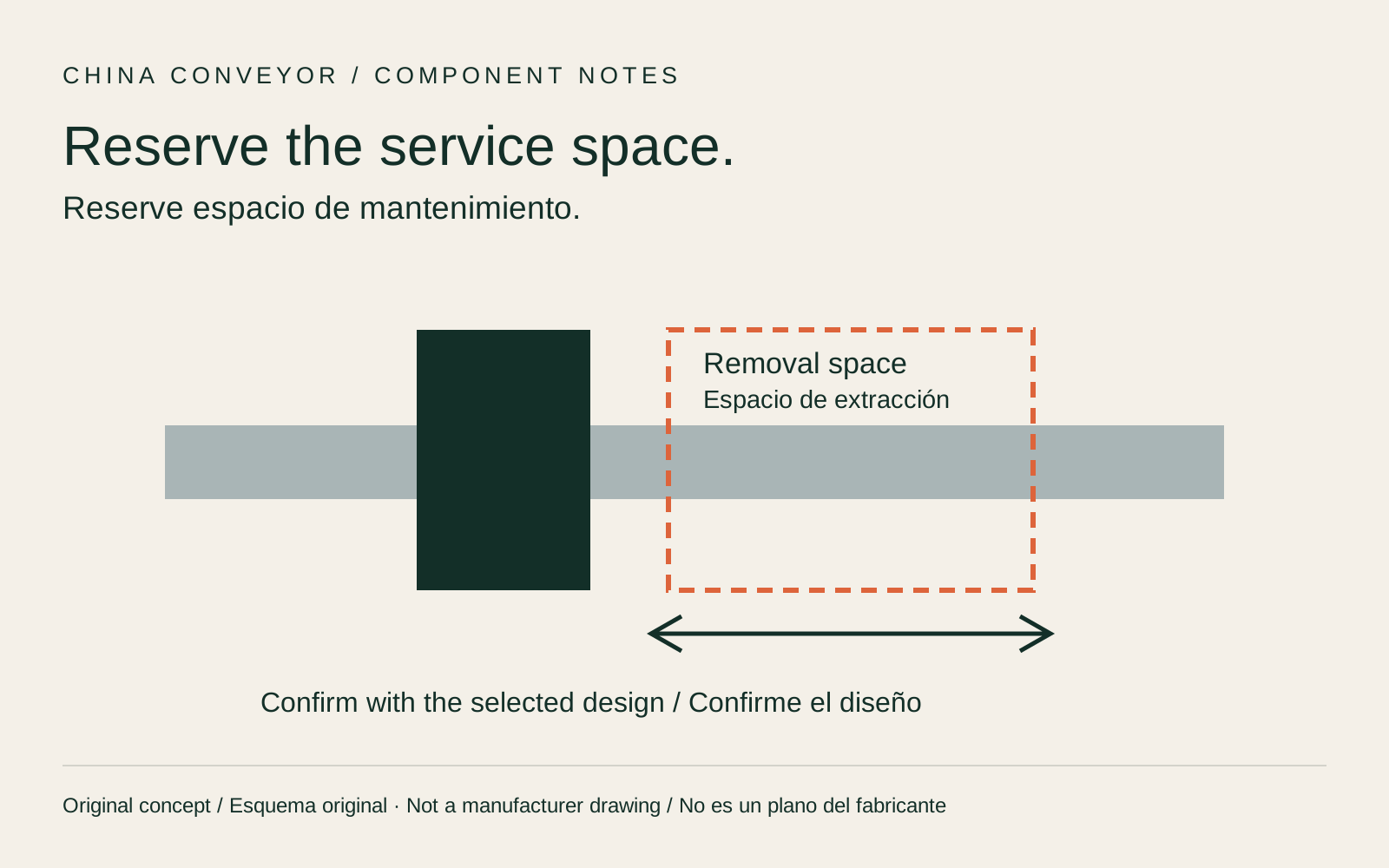
Ask for a drawing showing the take-up in relation to the belt, supporting structure, nearby equipment, access routes, and the maintenance work area. The drawing should make clear how an authorized worker reaches the inspection and adjustment points, how tools and replacement parts are brought in, and how components can be removed or installed. Where maintenance requires lifting or handling equipment, ask the designer to identify the planned handling route and any constraints that affect the task; do not assume a clear route from a general arrangement drawing.
Describe the intended approach to the work area, including any stairs, platforms, ladders, doors, or removable panels in the proposed design. Ask the supplier to identify obstructions, potential fall exposures, pinch or nip hazards, and places where a worker might have to reach across or beneath moving parts. Specify how guards are opened or removed for authorized maintenance and how they are restored before return to service. Do not accept an access concept that depends on reaching into a hazardous area while equipment is moving or on leaving a guard off for routine work.
Avoid treating a single clearance figure as proof of safe access. The required space depends on the actual task, the equipment, tools, handling method, and applicable site rules. Have the responsible designer confirm that the proposed arrangement supports the listed tasks and applicable local requirements. Ask for unresolved access limitations to be recorded in the handover information, rather than left implicit.
Map isolation and stored energy
Require an energy-source schedule for the conveyor and take-up, not only a note identifying the drive motor. Ask the responsible designer and site team to consider electrical power, mechanical movement, belt tension, gravity, and material that could move or fall, as applicable to the installation. The schedule should identify each relevant source, its isolation point, the equipment or area affected, and who is responsible for providing and maintaining the isolation information. Include connected equipment where its movement or material could create a hazard at the take-up.
For each maintenance task, request a written description of how the work area is made safe under the site’s approved energy-control process. The description should distinguish isolation from additional physical restraint. It should identify whether tension is retained, controlled, or released, and explain how unintended movement is prevented while people are exposed. Where belt clamps, counterweights, winches, or other restraints are part of the design or planned work method, require the designer or qualified site authority to specify their suitable application, anchorage, and limits. Do not invent a clamp capacity or restraint arrangement in the purchase specification; those are engineering decisions for the actual belt and structure.
The CMA guideline excerpt identifies stored energy as a maintenance hazard and mentions clamps anchored to the structure and controlled management of take-up tension. A Freeport-McMoRan site standard excerpt defines energy isolation and secondary blocking, including controls against movement from mechanical or gravitational forces. These sources support asking about both isolation and restraint. They do not authorize a particular procedure at another site, replace applicable law, or prove that a proposed device is adequate.
Require verification, safeguards, and responsibilities
Ask the supplier to provide the information needed for the site’s competent personnel to verify the energy-control state before work begins. The purchase documents should identify the relevant verification points and any equipment-specific instructions, while leaving the approved verification method to the applicable site procedure and qualified personnel. Include requirements for clear identification of isolation points and take-up controls, accessible maintenance information, and a process for reviewing changes to the conveyor or its control system.
Define responsibilities across design, installation, operation, and maintenance. The buyer should identify who approves the access arrangement, who reviews the energy-source schedule, who supplies site-specific isolation procedures, and who accepts the completed installation. Require unresolved hazards, assumptions, and operating restrictions to be listed for review before acceptance. The Freeport-McMoRan excerpt assigns responsibilities within its own operation and states that its standard does not prescribe procedures for every conveyor or component. It is therefore an example of why a buyer should name local owners, not a standard to impose on other sites without review.
Ask for guard and access provisions to be considered together. Maintenance access should not create an unguarded route to moving parts during operation, and guards should not prevent the planned safe maintenance tasks. Any design review should consider the applicable jurisdiction, site risk assessment, manufacturer information, and the specific configuration. The CMA guideline itself says that applicable legislation, local procedures, and approved risk assessments take precedence over its guidance.
Put a review checklist in the purchase or retrofit scope
Request a coordinated handover package containing the take-up identification and location; arrangement and access drawings; task and component removal assumptions; energy-source and isolation-point schedule; description of stored-energy hazards and planned restraints; guard and access information; equipment-specific instructions; and named review and acceptance responsibilities. Ask the supplier to identify information that is unavailable or depends on final site conditions. Keep revisions controlled so maintenance personnel can tell which drawings and instructions apply to the installed equipment.
At design review, ask: Can each listed task be reached using the designed access route? Can required parts and tools be moved to and from the work area? Are isolation points identifiable and included in the energy schedule? Has stored belt or gravitational energy been addressed, including the means of preventing movement where required? Are proposed restraints and their anchorage specified by a competent authority? Can guards be managed and restored without relying on unsafe access? Who verifies the design, the installation, and the site procedure before maintenance is authorized?
A complete specification documents the questions, design information, and responsibilities needed for a site-specific safe system of work. It does not itself make maintenance safe, certify a supplier, or replace engineering calculations, local legal review, training, risk assessment, or the employer’s energy-control procedures. If a supplier cannot answer a safety-critical question from the available design information, record it as an open item and obtain review before accepting the arrangement for the intended task.
This guide helps define questions and requirements. Technical decisions require application documentation and review.
Sources
https://sadpo.co.za/wp-content/uploads/2016/09/CMA-Guideline-Safety-Around-Belt-Conveyors.pdf ↗The 2013 CMA guideline excerpt supports discussing maintenance hazards, stored energy, lockout, take-up over-travel, and examples of managing take-up tension. It states that local law, procedures, and approved risk assessments take precedence; the retrieved text is incomplete.
https://publicportal.fmi.com/sites/publicportal/files/Files/Morenci_Files/SafeProductionStandards/Conveyor%20Safety%20Standard.pdf ↗The 2014 Freeport-McMoRan Morenci standard excerpt defines energy isolation and secondary blocking and describes responsibilities within that operation. It is site-specific and does not prescribe procedures for every conveyor or other site.